
 personal trainer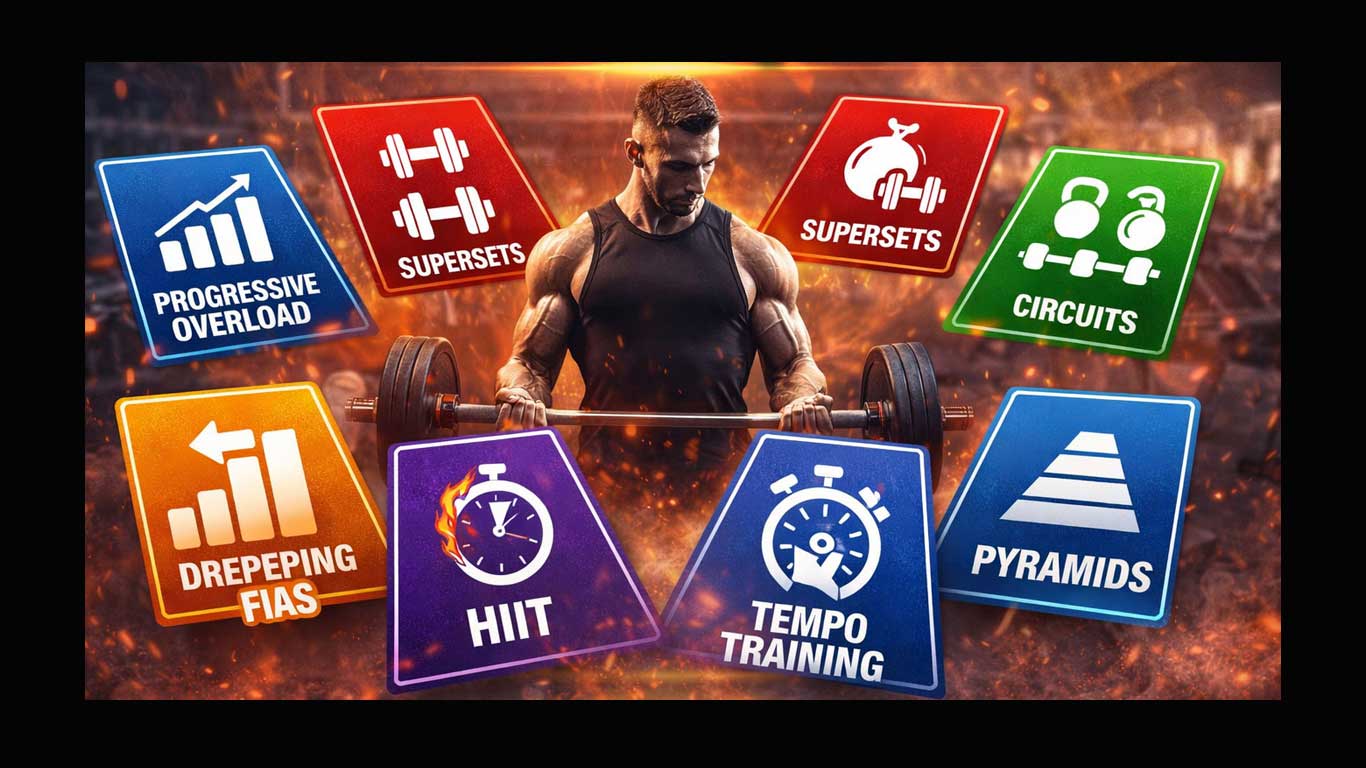
The Complete Guide to Training Methods
Core Training Methods
1. Progressive Overload
Gradually increasing the demands placed on your body over time. This can be done by adding weight, reps, or intensity. It’s the foundation of all strength and muscle development.
2. Linear Progression
A simple method where you consistently increase weight or reps each workout. It’s highly effective for beginners and early-stage lifters. Progress is predictable and easy to track.
3. Periodization
A structured approach that cycles intensity and volume over time. It helps prevent plateaus and reduces injury risk. Common types include linear and undulating periodization.
4. Time Under Tension (TUT)
Focuses on how long a muscle is under strain during each set. Slower reps increase muscle activation and control. It’s highly effective for hypertrophy.
5. Volume Training
Emphasizes total work performed (sets × reps × weight). Higher volume can stimulate muscle growth. Balance is key to avoid overtraining.
6. Intensity Training
Focuses on how hard you train relative to your maximum effort. Higher intensity means lifting closer to your limits. It’s critical for strength development.
7. Frequency-Based Training
Refers to how often you train each muscle group. Increasing frequency can improve skill and growth. Recovery must match frequency.
8. Full Body Training
Targets all major muscle groups in a single session. Efficient and ideal for beginners or time-limited schedules. Promotes balanced development.
9. Split Training
Divides workouts by muscle groups or movement patterns. Allows more focus and volume per area. Common splits include push/pull/legs.
10. Circuit Training
Moves quickly between exercises with minimal rest. Combines strength and cardio benefits. Great for conditioning and efficiency.
Strength & Power Methods
11. Heavy Sets
Uses low reps with high weight to build strength. Focuses on maximum force production. Requires proper form and rest.
12. Speed Training
Emphasizes explosive movement and fast execution. Improves power and athletic performance. Often uses lighter weights moved quickly. 13. Contrast Training
Pairs heavy lifts with explosive movements. This enhances power output through nervous system activation. Common in athletic training.
14. Cluster Sets
Breaks a set into mini-sets with short rest periods. Allows you to lift heavier with better quality reps. Reduces fatigue buildup.
15. Wave Loading
Alternates between heavier and lighter loads in waves. Helps improve strength through nervous system stimulation. Common in advanced programs.
16. Accommodating Resistance
Uses bands or chains to vary resistance through a lift. Increases difficulty where you are strongest. Enhances strength across the full range.
17. Isometric Holds
Holding a position under tension without movement. Builds strength at specific joint angles. Improves stability and control.
18. Eccentric Training
Focuses on the lowering (negative) phase of a lift. This phase creates significant muscle damage and growth. Often done slowly for control.
19. Plyometric Training
Explosive movements like jumps and bounds. Develops power and speed. Common in sports performance training.
20. Olympic Lifting Methods
Includes lifts like cleans and snatches. Focuses on explosive full-body movement. Requires technique and coordination.
Hypertrophy Methods
21. Drop Sets (Strip Sets)
Reduce weight immediately after reaching fatigue and continue. Extends the set and increases muscle stress. Great for hypertrophy.
22. Supersets
Perform two exercises back-to-back with no rest. Can target the same or opposing muscle groups. Saves time and increases intensity.
23. Giant Sets
Four or more exercises performed consecutively. Creates high volume and muscle fatigue. Often used for advanced training.
24. Rest-Pause Training
Short rest breaks within a set to extend effort. Allows more reps with the same weight. Increases intensity without increasing load.
25. Pyramid Sets
Gradually increase or decrease weight across sets. Builds both strength and endurance. Common in structured programs.
26. Reverse Pyramid Training
Start heavy, then decrease weight each set. Maximizes strength early when fresh. Efficient and effective.
27. Pre-Exhaust Training
Isolate a muscle before a compound movement. Ensures the target muscle is fatigued first. Enhances activation.
28. Post-Exhaust Training
Perform isolation work after compound lifts. Extends muscle fatigue. Great for finishing a muscle group.
29. Mechanical Drop Sets
Change exercise mechanics instead of weight. Allows continuation without reducing load. Keeps intensity high.
30. Forced Reps
A partner helps complete additional reps after failure. Extends the set beyond normal limits. Use sparingly due to intensity.
31. Partial Reps
Perform reps in a limited range of motion. Targets specific portions of a lift. Often used after full-range fatigue.
32. 21s Method
Breaks a set into three ranges of motion (7-7-7 reps). Increases time under tension. Common for arms.
33. Blood Flow Restriction (BFR)
Uses bands to restrict blood flow during training. Promotes growth with lighter weights. Effective and joint-friendly.
34. Occlusion Training
Similar to BFR, restricting circulation to increase stress. Enhances metabolic fatigue. Must be done carefully.
35. Constant Tension Training
Maintains tension throughout the entire movement. Avoids resting at the top or bottom. Maximizes muscle activation.
Conditioning & Fat Loss Methods
36. HIIT
Short bursts of intense effort followed by rest. Efficient for fat loss and conditioning. Time-effective.
37. LISS
Low-intensity steady cardio. Sustainable and easier to recover from. Great for fat loss.
38. EMOM
Perform a set every minute on the minute. Combines structure and intensity. Builds endurance.
39. AMRAP
Complete as many reps or rounds as possible. Encourages effort and pacing. Common in conditioning.
40. Tabata
20 seconds work, 10 seconds rest cycles. High intensity and short duration. Effective for fat loss.
41. MetCon
Blends strength and cardio into one workout. Improves overall conditioning. Common in functional training.
42. Sprint Intervals
Short, maximum-effort sprints with recovery. Builds speed and burns fat. Very demanding.
43. Ladder Workouts
Increase or decrease reps over time. Builds endurance and structure. Mentally engaging.
44. Density Training
Do more work in less time. Improves efficiency and conditioning. Focuses on productivity.
Advanced Techniques
45. Negative Accentuated Training
Extends the eccentric phase even longer. Increases muscle damage and control. Very intense.
46. Cheat Reps
Using slight momentum to complete reps. Allows extra work beyond failure. Must be controlled.
47. Iso-Dynamic Training
Combines holding and moving within a set. Builds both strength and endurance. Challenging and effective.
48. Pause Reps
Pause mid-rep to remove momentum. Increases difficulty and control. Enhances strength.
49. Tempo Training
Controls speed of each phase (e.g., 4-1-2). Improves technique and tension. Great for hypertrophy.
50. Overreaching Phases
Short periods of intense training beyond normal capacity. Followed by recovery for gains. Advanced method.
51. Deload Weeks
Reduce intensity to allow recovery. Prevents burnout and injury. Essential for long-term progress.
52. Failure Training
Training until you can’t complete another rep. Increases intensity. Should be used strategically.
53. Submax Training
Stops before failure (reps in reserve). Improves recovery and consistency. Sustainable approach.
Functional Methods
54. Functional Training
Focuses on real-world movement patterns. Improves daily performance. Enhances coordination.
55. Mobility Training
Improves joint range of motion. Reduces injury risk. Supports better movement.
56. Stability Training
Strengthens supporting muscles. Improves balance and control. Often uses unstable surfaces.
57. Core Bracing Techniques
Teaches proper core engagement. Supports lifts and protects the spine. Essential for strength.
58. Unilateral Training
Trains one side at a time. Fixes imbalances. Improves coordination.
59. Balance Training
Enhances control and stability. Useful for athletes and injury prevention. Builds coordination.
60. Movement Pattern Training
Focuses on basic patterns like squat, hinge, push, pull. Builds foundational strength. Improves efficiency.
MuscleRX Methods (The Edge)
61. Prescription-Based Training
Customized programs based on individual needs. Removes guesswork. Creates structure.
62. 4-Week Cycling Programs
Training evolves every 4 weeks. Prevents boredom and plateaus. Keeps progress consistent.
63. Progressive Phase Training
Each phase builds on the last. Structured progression over time. Maximizes results.
64. Goal-Based Programming
Programs designed for specific outcomes. Fat loss, strength, or performance. Focused and effective.
65. Environment-Based Training
Adapt workouts to your environment. Gym, home, beach, or travel. Removes barriers.
66. Adaptive Programming
Adjusts based on feedback and performance. Keeps training aligned with progress. Personalized evolution.
67. Hybrid Training
Combines strength and conditioning. Builds balanced fitness. Efficient and effective.
68. Minimal Equipment Training
Uses limited tools for effective workouts. Accessible and flexible. Ideal for consistency.
69. Time-Efficient Workouts
Designed for shorter sessions. Maximizes results in minimal time. Perfect for busy schedules.
70. Compliance-Based Training
Built for adherence, not perfection. Focuses on what you can sustain. Drives long-term results.
Train with purpose. Show up with consistency. Let time do the rest