
 personal trainer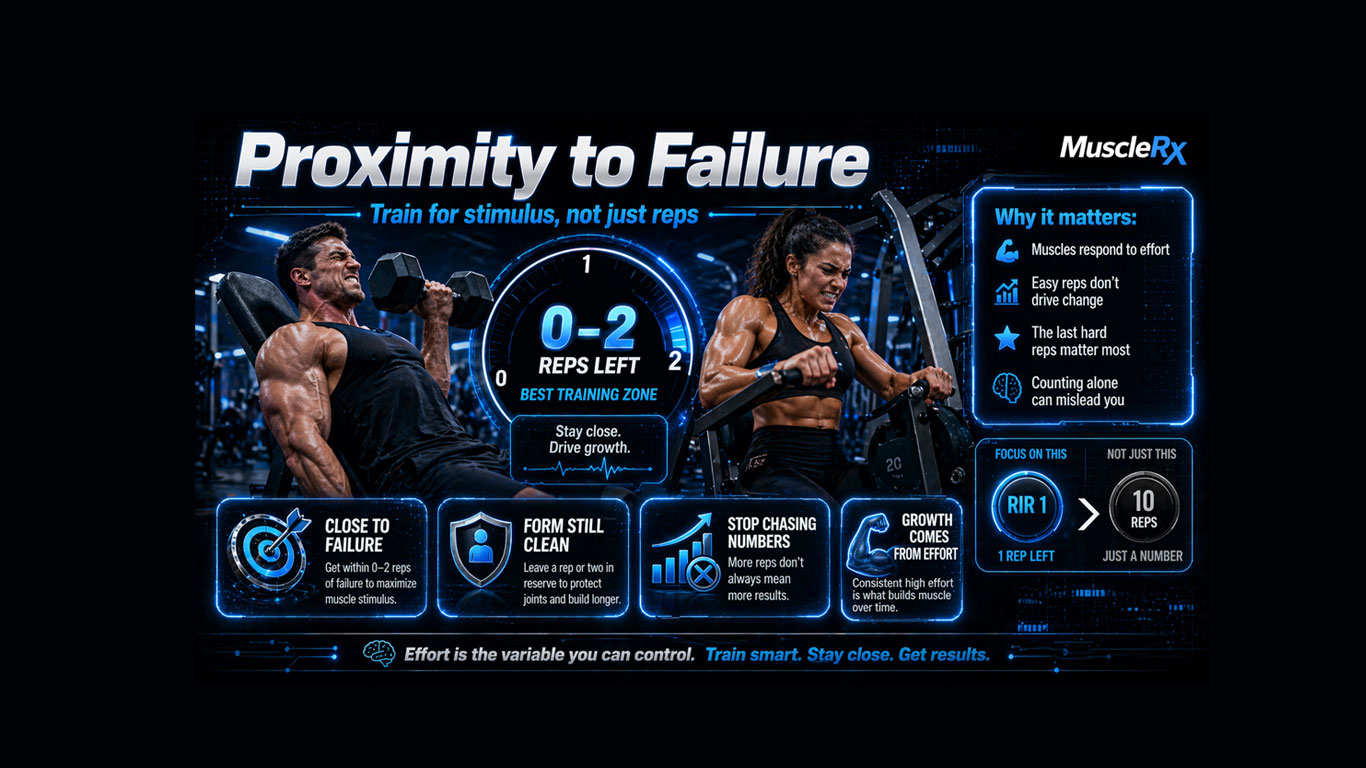
Proximity to Failure
Obsessed with hitting a number—8 reps, 10 reps, 12 reps
One of the biggest mistakes people make in the gym is turning training into a counting contest instead of a stimulus contest. They become obsessed with hitting a number—8 reps, 10 reps, 12 reps—as if the body somehow knows arithmetic. It does not. Your muscles do not grow because you reached rep number ten. They respond to tension, effort, fatigue, and how close you push them to the point where another good rep is no longer possible. That is why proximity to failure matters so much more than simply counting reps.
Failure, in the training sense, does not mean the weight crashes down or form completely falls apart. It means you have reached the point where you cannot perform another clean, controlled repetition. Training close to that point is what makes a set productive. If you stop too early, especially out of habit, comfort, or because the program says a certain number, you often leave the most meaningful reps on the table. Those last few difficult reps are usually the ones that create the signal for the body to adapt.
This is where counting can become a problem. Counting makes people quit before the set is actually doing its best work. Someone decides ahead of time that they are doing ten reps, reaches ten, and racks the weight, even though they may have had three or four strong reps left. On the surface it feels disciplined, but in reality it can be lazy training disguised as structure. The set was not hard because the muscle was finished. It ended because the mind saw a number and shut it down.
The opposite happens too. Some people chase numbers with sloppy form just to say they got their reps. That is no better. A set of twelve ugly reps with momentum, bouncing, and shortened range of motion is not superior to a set of eight or nine controlled reps taken near true failure. In fact, it is usually worse. The goal is not to survive a rep target. The goal is to challenge the muscle so deeply that it has a reason to get stronger or grow.
Training with proximity to failure changes the way you think about effort. Instead of asking, “How many reps am I supposed to do?” you start asking, “How many good reps do I have in me today?” Some days a weight that usually gives you twelve hard reps may only give you nine. Other days it may give you thirteen. That is normal. Strength, energy, recovery, sleep, stress, and focus all change performance. Fixed rep counting ignores that reality. Proximity to failure respects it.
This does not mean every set of every exercise needs to be taken to absolute failure. That would be exhausting, hard to recover from, and in some lifts unnecessarily risky. But most productive training should live in that neighborhood. You want to finish a set knowing you were close. Maybe one rep left. Maybe two. Sometimes none. That is where honest effort lives. That is where the set becomes more than movement and becomes training.
A lot of lifters stay too far from failure because discomfort arrives before true fatigue. The burn starts, breathing gets harder, the movement slows down, and they assume the set is done. It is not. Very often that is where the set starts to become effective. The muscle has finally been challenged enough that the easy reps are gone. What comes next is the part most people avoid, which is also why most people look the same month after month. They are working, but they are not working close enough to the edge to force change.
Counting still has some value, but only as a rough way to record performance, not as the mission of the set. Reps are a tool for tracking. They are not the target itself. If you wrote down that you got eleven reps with a certain weight last week and nine this week, that is useful information. But the real question is whether both sets were taken close enough to failure to be meaningful. If one set ended with four reps still in reserve, the number is far less impressive than it looks on paper.
This is one reason experienced lifters often get more out of lighter weights than beginners get out of heavier ones. The experienced lifter knows how to stay controlled, keep tension where it belongs, and continue pushing when the set becomes uncomfortable. The beginner often counts reps, moves too fast, and stops at the first sign of effort. Same exercise, same machine, totally different stimulus. The difference is not just weight on the stack. It is proximity to failure.
The body responds to challenge, not comfort. If you want better results from your training, stop worshipping rep numbers and start respecting effort. Use good form, control the weight, and push the set until you are honestly near the point where another clean rep is not there. That approach is harder, more honest, and far more effective than simply stopping because you hit a number you decided on before the set ever began.
For most people, better training starts when counting stops being the goal. The set should end because the muscle is close to done, not because the mind reached ten.
Your body doesn’t care where your protein comes from—it cares that you show up and use it.