
 personal trainer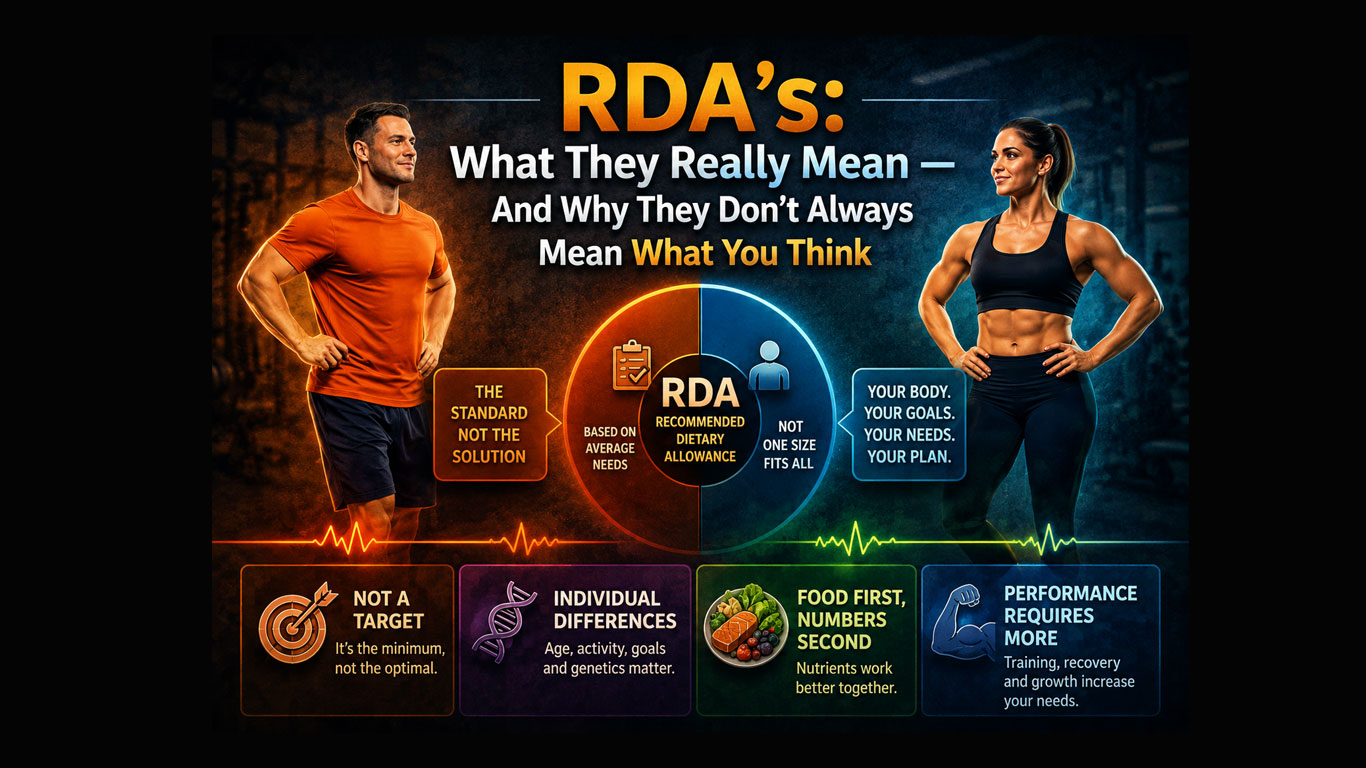
RDA’s: What They Really Mean
� Why They Don’t Always Mean What You Think
Walk through a grocery store or supplement aisle and you are constantly surrounded by percentages. Vitamin C may say 100% Daily Value. Magnesium might say 20%. Calcium could say 35%. For many people, those numbers create a sense of reassurance. If the label says 100%, the assumption is often simple: “I’m getting everything I need.”
But Recommended Dietary Allowances, commonly known as RDA’s, are frequently misunderstood. While they serve an important purpose in public health and nutrition, they were never designed to represent perfect nutrition for every individual, lifestyle, or health goal.
RDA’s were originally created to establish minimum nutrient intake levels needed to prevent severe deficiency diseases within the general population. Historically, this meant preventing conditions such as scurvy, rickets, pellagra, or beriberi. The goal was often centered around preventing outright deficiency, not necessarily maximizing athletic performance, recovery, longevity, cognitive function, or metabolic optimization.
That distinction is important because there is a major difference between consuming enough nutrients to survive and consuming enough nutrients to truly thrive.
One of the biggest misconceptions surrounding RDA’s is the belief that they are personalized recommendations. In reality, they are generalized population-based estimates. They are designed around averages and broad categories such as age and gender. Human beings, however, are anything but average.
A sedentary office worker and a high-level athlete may have completely different nutritional demands. The same can be true for: • shift workers • aging adults • people under chronic stress • individuals recovering from illness or injury • highly active fitness enthusiasts • people with digestive disorders or absorption issues
Lifestyle alone can dramatically alter nutrient requirements.
For example, an endurance athlete losing minerals through sweat may require significantly more electrolytes and magnesium than someone with a sedentary lifestyle. Resistance training can increase protein turnover and tissue repair demands. Chronic stress may influence nutrient utilization, sleep quality, recovery, and hormonal balance. Yet nutrition labels often present one standardized number as though it applies equally to everyone.
Another important issue is that RDA’s are often interpreted as optimal intake levels when they may actually represent minimum thresholds designed to avoid obvious deficiency symptoms. A person might technically consume enough magnesium to avoid a diagnosed deficiency while still experiencing poor sleep, muscle cramps, fatigue, stress sensitivity, or impaired recovery. Likewise, someone may consume enough protein to avoid malnutrition while still falling short of what is needed to support muscle growth, healthy aging, or athletic recovery.
This is where many people become confused. Terms like “adequate,” “normal,” and “optimal” are often treated as though they mean the same thing, but they do not.
The problem becomes even more complicated when food manufacturers use RDA percentages as marketing tools. A highly processed food may advertise impressive vitamin percentages while still lacking overall nutritional quality. Consumers may then assume they are meeting their nutritional needs because the label appears complete on paper.
What often gets overlooked is that nutrient intake and nutrient absorption are not the same thing.
The human body’s ability to absorb and utilize nutrients can vary tremendously depending on multiple factors, including: • digestive health • inflammation • medication use • gut health • sleep quality • alcohol consumption • aging • nutrient interactions • stress levels
A person may consume a nutrient consistently while still struggling to absorb or utilize it efficiently. Magnesium, iron, vitamin B12, and other nutrients can all be affected by absorption challenges. This is one reason why simply chasing Daily Value percentages can create a false sense of nutritional security.
Athletes and highly active individuals often expose the limitations of generalized nutritional recommendations most clearly. Training places unique stress on the body. Tissue repair, recovery, sweat loss, inflammation, oxidative stress, and increased metabolic demand all influence nutritional needs. Someone training intensely multiple days per week may require nutritional support well beyond standardized minimum recommendations.
This does not automatically mean that “more is always better.” Excessive supplementation can create its own problems. But it does highlight the importance of context and individualization.
Modern nutrition science is increasingly moving toward personalized approaches that consider biomarkers, recovery demands, metabolic health, genetics, activity levels, and lifestyle factors. Instead of asking, “What does the average person need?” the better question may be, “What does this individual need based on their physiology, goals, and environment?”
That shift changes the conversation entirely.
Despite their limitations, RDA’s still play an important role. They provide foundational nutritional guidance, establish public health baselines, and help prevent widespread deficiency diseases across populations. Without some form of standardized nutritional framework, large-scale public health recommendations would be extremely difficult to manage.
The issue is not necessarily that RDA’s exist. The issue is how they are interpreted.
They were never intended to be a perfect blueprint for every human body, every activity level, or every health goal. They are best viewed as a foundational starting point rather than a universal endpoint.
Nutrition is dynamic. Human biology is highly individualized. Two people eating the exact same diet may experience dramatically different outcomes based on genetics, lifestyle, stress exposure, training demands, recovery, and absorption efficiency.
As nutritional science continues to evolve, one of the most important realizations may be this: avoiding deficiency and achieving optimal health are not always the same thing.
If your form breaks, your results break. Control the movement—control the outcome.