
 personal trainer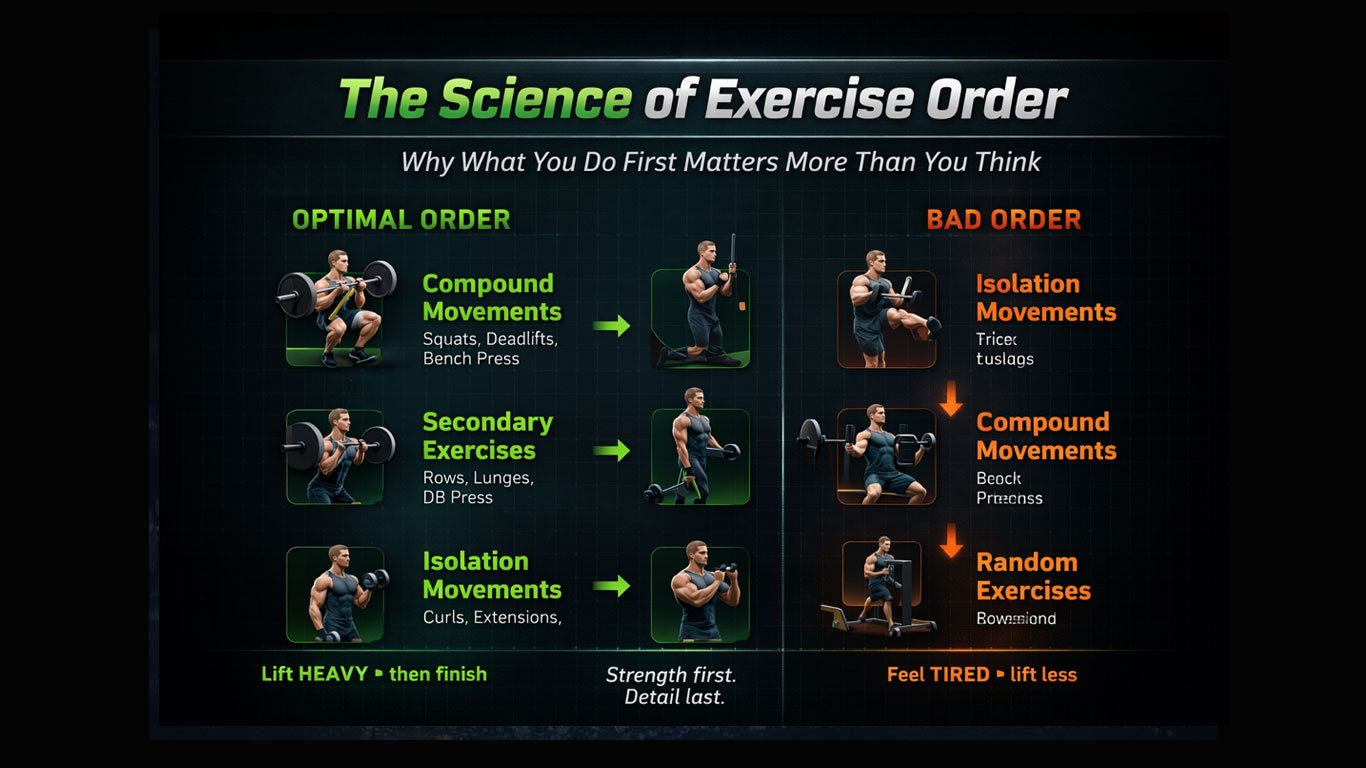
Chest press, then triceps, then back to chest
� Why What You Do First Matters More Than You Think
Most people walk into the gym and start wherever there’s an open machine. Chest press, then triceps, then back to chest, then maybe legs—there’s no real structure, just movement. It feels productive, but underneath, it’s inefficient and often limits real progress.
Exercise order isn’t random. It directly affects strength output, muscle recruitment, fatigue management, and overall results. The sequence of your workout determines how much force your body can produce and how effectively you can train each muscle group. When the order is wrong, performance drops before it even has a chance to peak.
Your body performs best when it’s fresh. The first exercises in your workout receive the most energy, the most focus, and the highest level of force production. This means whatever you do first gets the greatest training stimulus. If that energy is spent on smaller muscles or isolation work, you’re taking away from movements that require full-body coordination and strength.
That’s why workouts should follow a logical progression. The most demanding exercises—those that use multiple muscle groups—should come first. Movements like squats, deadlifts, bench press, pull-ups, and overhead press require the most energy and coordination. Performing them early allows you to lift heavier, recruit more muscle fibers, and create a stronger growth stimulus.
Once those primary movements are complete, the workout can shift to secondary exercises that still build strength but with less overall demand. These movements support the main lifts and continue to develop muscle without requiring the same level of output. As fatigue builds, the focus transitions naturally toward more controlled and targeted work.
Isolation movements belong at the end of the workout. By this point, the body is already fatigued, which makes it an ideal time to focus on individual muscles. Exercises like curls, tricep work, or lateral raises are most effective when they are used to finish a muscle group, not when they are done at the beginning and reduce performance on bigger lifts.
When exercise order is ignored, performance suffers. If smaller muscles are trained first, they fatigue early and limit what larger movements can accomplish. For example, training triceps before a pressing movement reduces the ability to generate force during that lift, which lowers the effectiveness of the entire exercise. The issue isn’t just fatigue—it’s misplaced fatigue.
Many people assume that feeling exhausted means they had a good workout, but fatigue alone isn’t the goal. Without structure, fatigue becomes random stress instead of purposeful training. The goal is to maximize output when it matters most, not just to feel tired by the end.
A structured workout creates a clear path from high output to targeted fatigue. It allows the body to perform at its best early in the session, then gradually shift toward more focused work as energy decreases. This approach leads to better strength gains, improved muscle development, and more consistent progress over time.
When workouts are unstructured, they often lead to plateaus. Energy is wasted on movements that don’t require it, and performance on key exercises is reduced. Over time, this creates the feeling of working hard without seeing results.
The difference between progress and stagnation often comes down to structure. Two people can spend the same amount of time in the gym, but the one who follows a logical exercise order will get more out of every session. It’s not about doing more—it’s about doing things in the right sequence.
The simplest way to think about it is this: train big movements first, then move to smaller ones. Strength comes first, and detail comes last. When you follow this structure, every part of your workout builds on the previous one instead of working against it.
The gym isn’t just about effort. It’s about execution.
Steady energy beats quick spikes every time.