
 personal trainer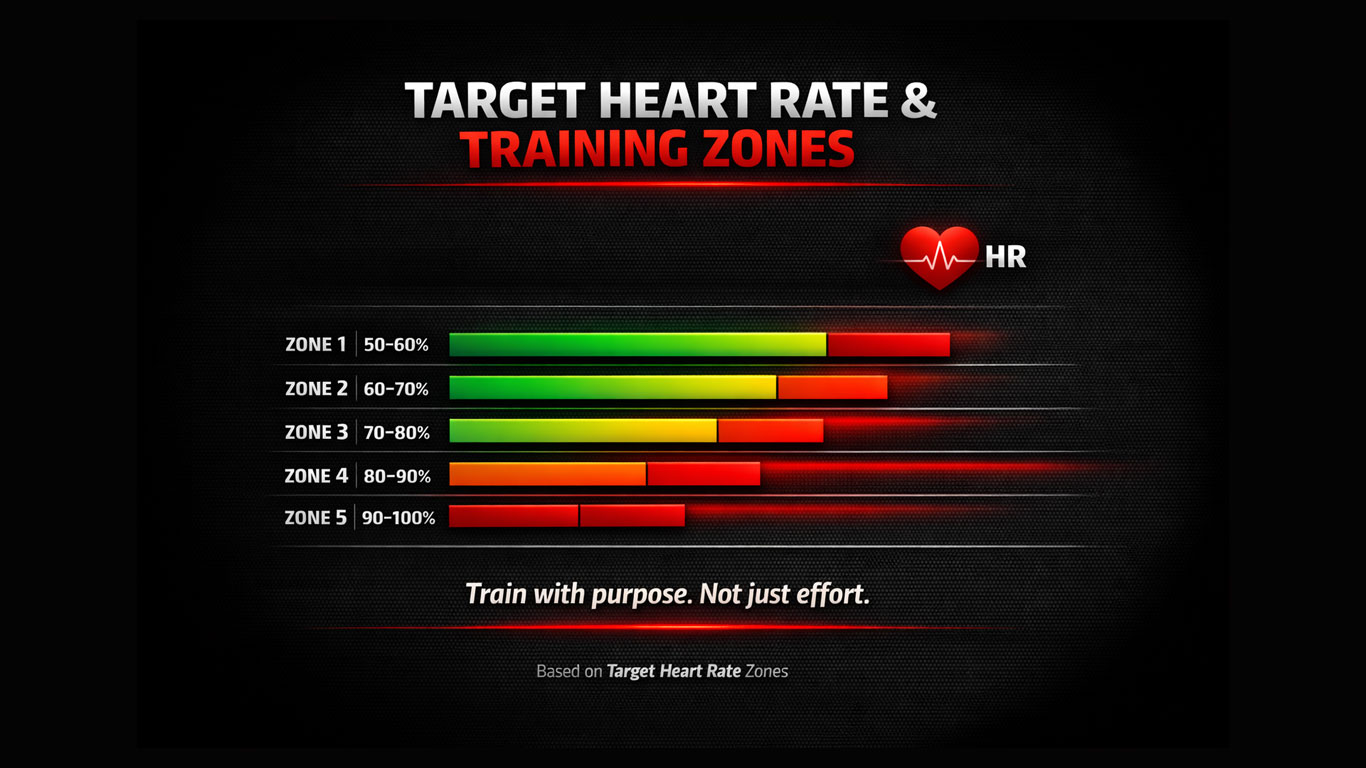
Target Heart Rate & Training Zones
� Train with purpose, not just effort
Most people approach cardio with a simple mindset: work hard, sweat, and hope it’s enough. If it feels intense, it must be effective. If you’re tired at the end, it must be working. But your body doesn’t adapt based on how something feels—it adapts based on the physiological stress placed on it. That’s where understanding your heart rate becomes powerful. It removes the guesswork and replaces it with something measurable, repeatable, and purposeful.
Target heart rate is the range your heart should be working within during exercise to achieve a specific outcome. While many people rely on a simple estimate using maximum heart rate, a more accurate and personalized approach is the Karvonen Heart Rate Formula. This method accounts not only for your age, but also your resting heart rate, giving you a clearer picture of how your body actually responds to effort.
The formula works by first estimating your maximum heart rate using 220 minus your age. From there, you subtract your resting heart rate to determine your heart rate reserve. This number represents the usable range your heart can operate within during training. You then multiply that reserve by your desired intensity level and add your resting heart rate back in. The result is your target heart rate for that specific zone.
This approach matters because two people of the same age can have very different resting heart rates, and therefore very different fitness levels. The Karvonen formula adjusts for that, making your training zones more personal, more accurate, and more effective.
Once you establish your target heart rate, your training can be divided into five distinct zones, each representing a different level of intensity and each producing a different adaptation in the body.
The first zone
is the recovery zone. This is where effort is light, breathing is easy, and movement feels almost effortless. It may not feel like much, but it plays a critical role in recovery, circulation, and maintaining consistency. This is also where beginners should spend much of their time, building a base without overwhelming the system.The second zone
is often referred to as the fat-burning or base zone, but its true value goes far beyond that label. This is where endurance is built and where the body becomes more efficient at using energy. It is one of the most important zones for long-term fitness and longevity. Training here improves your ability to sustain effort and recover faster, making everything else you do more effective.The third zone
represents moderate intensity. Breathing becomes more noticeable, effort becomes more focused, and the body is working at a level that begins to challenge your current capacity. This zone improves aerobic fitness and bridges the gap between easy training and high-performance work.The fourth zone
is where training becomes hard. Effort is high, conversation becomes difficult, and your body is pushed closer to its limits. This zone is where speed, power, and performance are developed. It is effective, but it must be used with intention, as too much time here without proper recovery can lead to fatigue and stagnation.The fifth and final zone
is maximum effort. This is all-out intensity—short, explosive, and demanding. It cannot be sustained for long and is not meant to be. This zone is used for peak output and advanced conditioning. It is something you visit briefly, not where you build your foundation.Understanding these zones is only valuable if you apply them with purpose. Different goals require different distributions of effort. Fat loss and longevity benefit from consistent work in lower zones, where the body becomes efficient and sustainable. Performance and conditioning require strategic exposure to higher intensities, where the body is forced to adapt to greater demands.
One of the most common mistakes is spending too much time in the middle. Not easy enough to recover, but not hard enough to improve. This “gray zone” feels productive, but often leads to plateaus and burnout. Without realizing it, many people train here almost exclusively, working hard without creating meaningful progress.
When you begin to use the Karvonen formula and train within defined heart rate zones, everything becomes clearer. Easy days are truly easy. Hard days are intentionally hard. Progress becomes more structured, recovery becomes more effective, and results become more predictable.
The MuscleRx approach is simple: don’t just do cardio—train your system. Understand your zones, personalize your intensity, and execute with purpose. Because when you learn how to control your effort, you’re no longer guessing. You’re building a system that drives performance, supports longevity, and delivers results that actually last.
If your form breaks, your results break. Control the movement—control the outcome.