
 personal trainer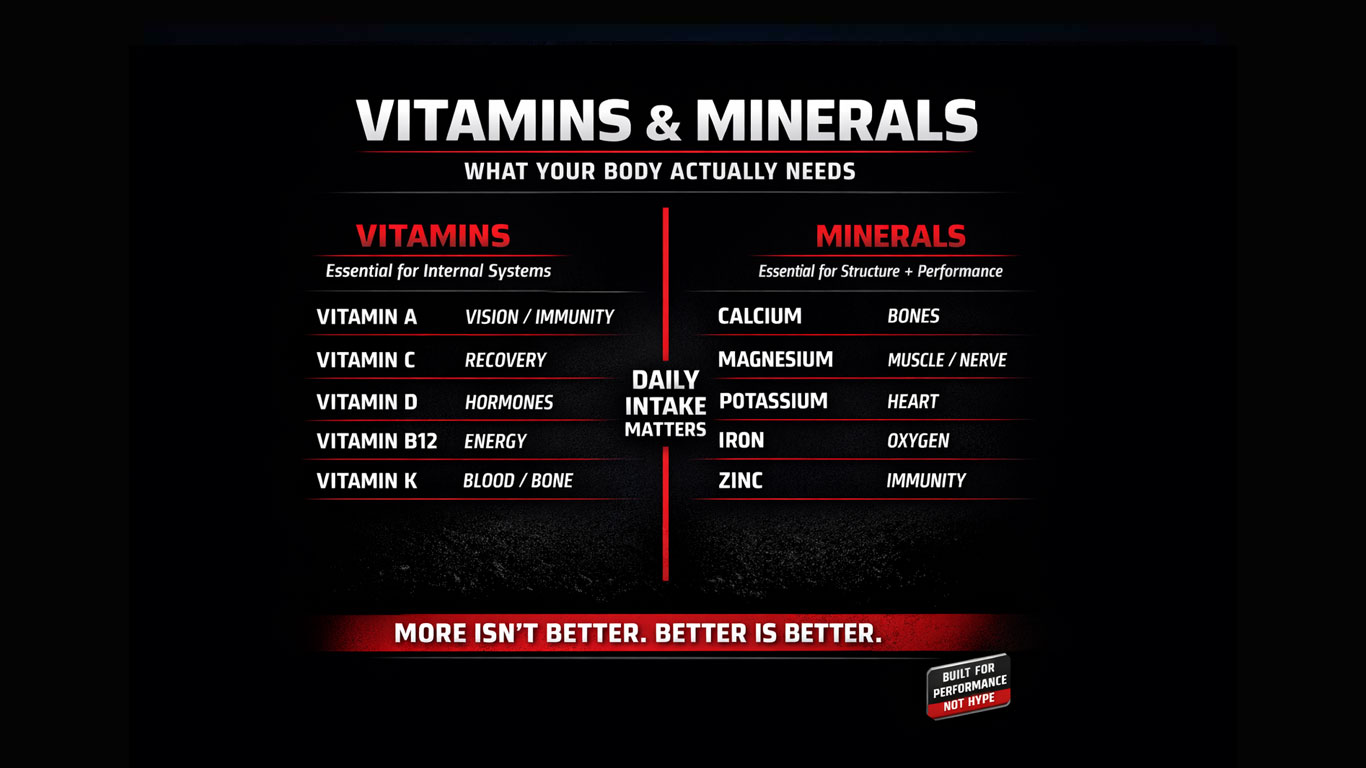
What You Actually Need (And What to Avoid)
� Not all supplements are created equal
Walk into any store or scroll online and you’ll see shelves filled with vitamins and minerals promising more energy, better immunity, faster recovery, and longer life. It all looks essential. It all feels necessary. But most of it is noise.
The reality is simple: most people don’t need more supplements—they need more clarity.
Vitamins and minerals are essential nutrients your body relies on for basic function, repair, and performance. Without them, systems begin to break down. But taking more than you need doesn’t improve results. In many cases, it creates imbalance. Understanding micronutrients isn’t about taking everything available. It’s about knowing what your body actually needs, how much is enough, and what you’re really putting into your system.
At the center of this is the Recommended Daily Allowance, or RDA. This is the baseline amount your body needs each day to maintain normal function and prevent deficiency. It is not a performance target. It is not a “more is better” number. It is simply the level required to keep your system operating as intended.
| Vitamin | Men | Women | Purpose |
|---|---|---|---|
| Vitamin A | 900 mcg | 700 mcg | Vision, immune function |
| Vitamin C | 90 mg | 75 mg | Recovery, immune support |
| Vitamin D | 600–800 IU | 600–800 IU | Hormones, bone health |
| Vitamin E | 15 mg | 15 mg | Antioxidant |
| Vitamin K | 120 mcg | 90 mcg | Blood clotting |
| B1 (Thiamine) | 1.2 mg | 1.1 mg | Energy metabolism |
| B2 (Riboflavin) | 1.3 mg | 1.1 mg | Cellular function |
| B3 (Niacin) | 16 mg | 14 mg | Energy production |
| B5 | 5 mg | 5 mg | Hormone production |
| B6 | 1.3–1.7 mg | 1.3–1.5 mg | Brain function |
| B7 (Biotin) | 30 mcg | 30 mcg | Metabolism |
| B9 (Folate) | 400 mcg | 400 mcg | DNA synthesis |
| B12 | 2.4 mcg | 2.4 mcg | Nerve function |
| Mineral | Men | Women | Purpose |
|---|---|---|---|
| Calcium | 1000 mg | 1000 mg | Bone strength |
| Iron | 8 mg | 18 mg | Oxygen transport |
| Magnesium | 400–420 mg | 310–320 mg | Muscle + nerve function |
| Potassium | 3400 mg | 2600 mg | Heart + fluid balance |
| Sodium | <2300 mg | <2300 mg | Electrolyte balance |
| Zinc | 11 mg | 8 mg | Immune function |
| Phosphorus | 700 mg | 700 mg | Energy systems |
| Copper | 900 mcg | 900 mcg | Iron metabolism |
| Manganese | 2.3 mg | 1.8 mg | Metabolism |
| Selenium | 55 mcg | 55 mcg | Antioxidant |
| Iodine | 150 mcg | 150 mcg | Thyroid function |
| Chromium | 35 mcg | 25 mcg | Blood sugar control |
| Molybdenum | 45 mcg | 45 mcg | Enzyme support |
Some vitamins are fat-soluble, meaning they are stored in the body and can accumulate over time. Vitamin A, Vitamin D, Vitamin E, and Vitamin K fall into this category. Because they are stored, excessive intake can build up and potentially create issues if not managed properly.
Other vitamins, along with most minerals, are either water-soluble or tightly regulated by the body. They still require balance. Too little leads to deficiency, but too much—especially from supplements—can disrupt normal function.
The real issue with supplements today is not just dosage—it’s quality. Many products are built for manufacturing efficiency, not biological effectiveness. To keep costs low and production fast, companies often include fillers, binders, and artificial additives that add no nutritional value and can sometimes interfere with absorption.
Ingredients like magnesium stearate are commonly used to speed production but may reduce absorption efficiency. Artificial colors such as Red 40 or Yellow 5 serve no purpose other than appearance. Titanium dioxide has raised concerns and has even been restricted in some regions. Other additives like microcrystalline cellulose, silicon dioxide, and hydrogenated oils are commonly used as fillers or stabilizers, but they contribute nothing to your health.
Most people never look at the “other ingredients” section. They focus on the front label—the promises, the branding, the claims—without realizing that what’s inside the capsule often matters more than the nutrient itself.
Choosing better supplements starts with asking better questions. What do you actually need? Is the ingredient list clean? Is the form absorbable? Is the product transparent about what’s inside?
Even with high-quality supplements, they should never replace the foundation.
The best source of vitamins and minerals is still real food. Whole foods provide nutrients in their natural form, along with enzymes and co-factors that help your body absorb and use them properly. A diet built on whole, nutrient-dense foods will always outperform a supplement stack trying to compensate for poor nutrition.
Supplements have a role, but it is a supporting role. They are meant to fill gaps, not define your strategy.
The MuscleRx approach is simple. Don’t chase more—chase better. Understand what your body requires, avoid what it doesn’t, and focus on what actually gets used.
Because in the end, results don’t come from what you take. They come from what your body can actually use.
It’s not how long you train. It’s how well you train.